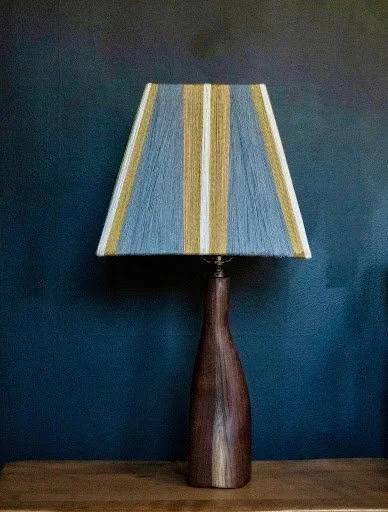
Earth Day often invites us to think big—climate policy, global emissions, planetary futures. At bftn, we are constantly returning to more appropriate and accessible scales: the materials in our daily lives. For most of human history the things that made up our daily lives were grown from the land and made by communities who used the environments around them. Textile and dye traditions tell us about what grows on our planet, how humans have innovated and manipulated plants to create our material needs, and how to honor the earth by producing in reverence of it.
A recent project we completed at bftn offers a pathway to think about how we can create in a way that honors the earth, our only home—provider of all that we need. Through a recent grant, we made a lamp. Decor can seem like a frivolous way to talk about earth-based production, but we decided to use it as an entry point to think about sustainable materials, Black artisans and cultural preservation.
A Lamp Is a Result of a Living System
Through a recent grant, bftn piloted the creation of sustainable home décor pieces centering Black farmers, artisans, and small producers. One of those pieces—a hand-crafted lamp—embodies a layered story of land, labor, and regeneration.
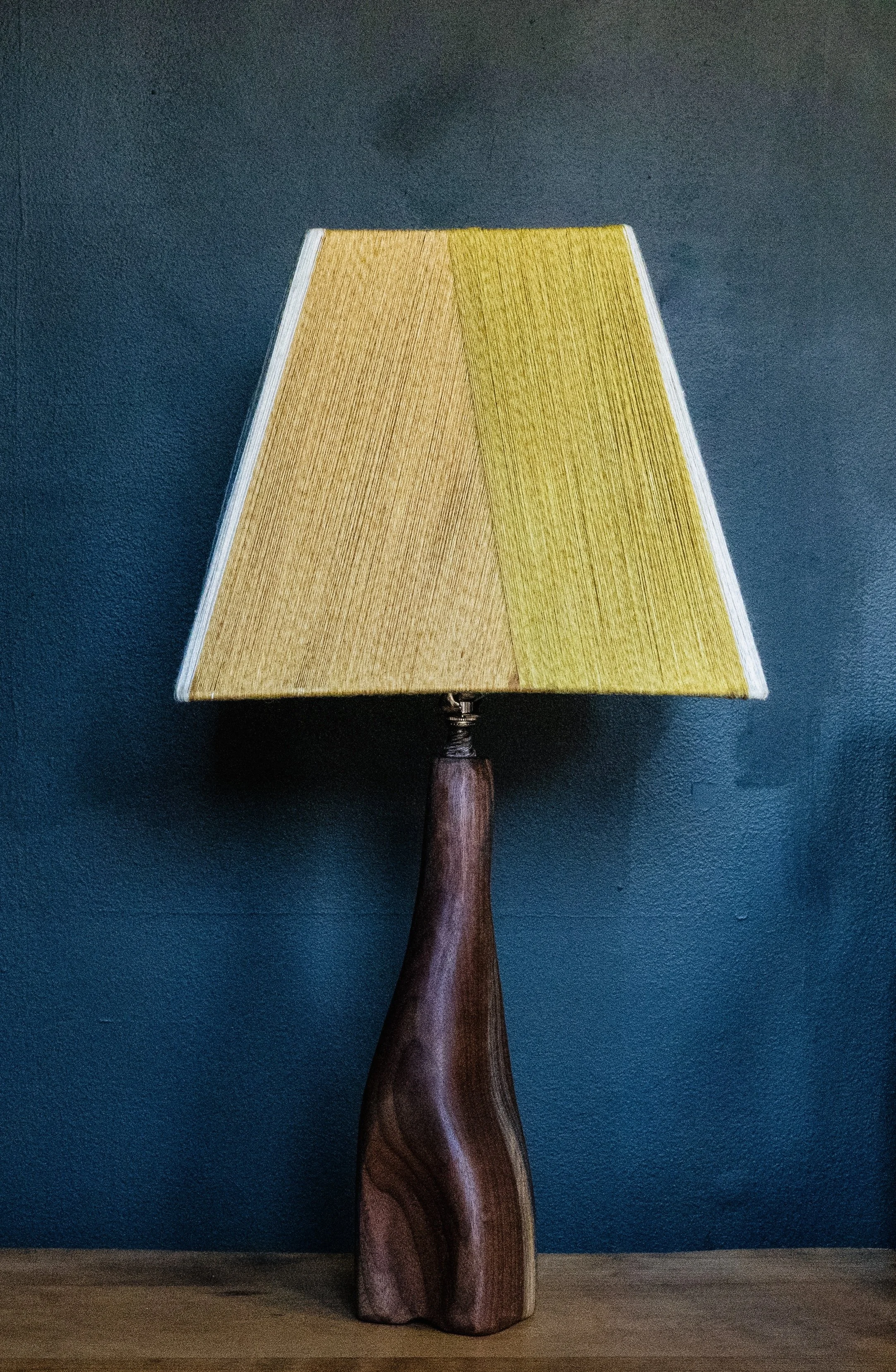
The base, created by Nifemi Ogunro, began as reclaimed walnut lumber. Rather than sourcing new lumber, the material was given a second life—honoring what already exists. The wood went through many woodworking processes to be suitable for a decor item. Once the wood was shaped and formed, it was sanded to an unusually fine 1000 grit. For reference, wooden home décor typically only requires sanding up to 320 grit. Our woodworker dedicated substantial time to achieving a smooth, refined facade. The base was finished with mineral oil rather than traditional finishes such as polyurethane, which contain harsh chemicals and are derived from polymers. Avoiding synthetic coatings preserves a more direct relationship between material and environment and resists the use of oil-based byproducts, which make up so much of our material world.
I created the lampshade. It carries its own set of relationships. The frame for the shade was made from deconstructed frames sourced at a local Goodwill. Rather than using new metal, I decided to use what already existed and had been discarded. If we were to only re-use materials that already exist, we could still create millions of new things. We do not need to use virgin materials in many cases. The yarn used for the shade is a story of collaboration and regional connection. It is a cotton and wool blend yarn developed by New York Textile Lab and Seed2Shirt, combining cotton grown by Black farmers in the southeastern United States with alpaca fiber from small farms in New York.
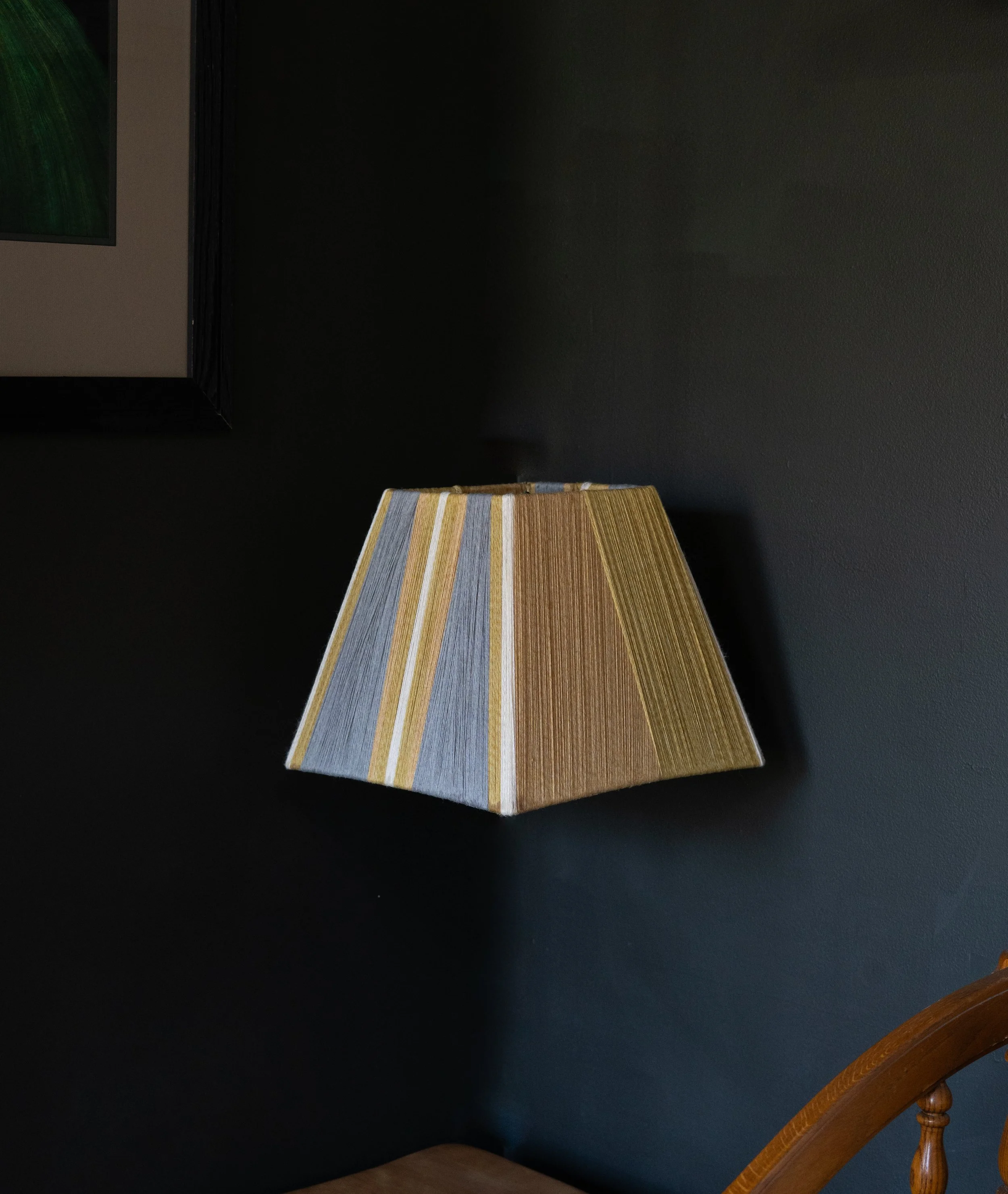
Before the shade was woven I dyed the yarn to create the colorways for the shade design. I used cosmos flowers to create the brownish yellow, coreopsis brought the deeper mustard tone, and black scabiosas produced soft blue-gray hues. I sourced these dye plants from High Hog Farm in Grayson, Georgia. These plant-based dyes do more than color fiber—they carry the seasons, soil conditions, and care practices of the farm where they were grown. The blend of cotton (plant fiber) and wool (protein fiber) creates a natural marbling effect, as each fiber absorbs natural dye differently. What emerges is variation, depth, and a quiet refusal of uniformity. After the yarn was dyed and wound, the lamp shade was woven by hand over several weeks. The lamp shade has four sides, two sides mirror each other. I made this choice since Nifemi constructed the base organically so that various contours can be seen from different angles. To compliment this intention, I wanted the lampshade to also provide different perspectives from various angles.
Beyond Sustainability: Toward Cultural Regeneration
Too often, “sustainability” in textiles is oversimply reduced to less harm: fewer chemicals, lower impact, incremental change. But this project asks a deeper question: how can fiber and dye practices actively come from regenerative systems? Regeneration is not just about materials; it’s about relationships, microgeographies and the culture surrounding our stuff and our consumption.
To land: sourcing plant dyes from farms that are stewarded with care, where soil health and biodiversity are centered.
To people: ensuring Black farmers, artisans, and small producers are resourced and their livelihoods are supported.
To craft: valuing time-intensive, knowledge-rich practices like handweaving and natural dyeing that are centuries old—produced from the environment and biodiversity of regions around the globe.
To waste: reclaiming materials and limiting waste—whether walnut wood or lampshade frames—and reimagining their present to support sustainable futures.
Our approach resists the speed and scale of industrial production. It insists that slowness, intention, and specificity are not inefficiencies—they are necessary conditions for ecological and cultural repair. They are a calling back to past practices that will give us greater possibilities for the future.
The form of the lampshade itself is not new. Variations of this style have long existed across North, Central, and West Africa, made from raffia and dried grasses—materials tied to local ecologies and cultural practices. Today, similar silhouettes are reappearing in Western interior design under labels like “organic modern” or “bohemian.” This resurgence presents an opportunity. These designs don’t have to be detached from their histories and reproduced through extractive supply chains. Their renewed popularity is an opening to invest in regenerative, regional production, and cultural acknowledgment.
Earth Day Is Practice, Not A Performance
This lamp is a process and a practice. It is a way of working that brings us closer to alignment with the earth. Honoring the earth through fiber, dye and textiles is not about a single material choice or aesthetic. It is about rethinking systems of production and value. It asks us to consider:
What does it mean to make alongside, rather than take from, the land?
How do we design for continuity—so materials can return, renew, and regenerate?
How do we ensure that the people most connected to land and craft are also those who are most supported?
This Earth Day, we invite our community to see textiles not just as products, but as relationships—that connect us to soil, to culture, and to each other.